![White Label Cosmetics Explained: Pros & Cons in 2025 [+Guide]](https://www.spypharma.com/uploads/blog/white-label-cosmetics-explained.jpg)
White Label Cosmetics Definition
White label cosmetics are standardised and often pre-produced cosmetic products that are branded with your logo. Standardised means that the formulation and packaging are already set and cannot be changed.
White Label Cosmetics vs. Private Label Cosmetics
White label cosmetics sometimes get lumped in with private label cosmetics. Some cosmetic manufacturers call private label what another might call white label.
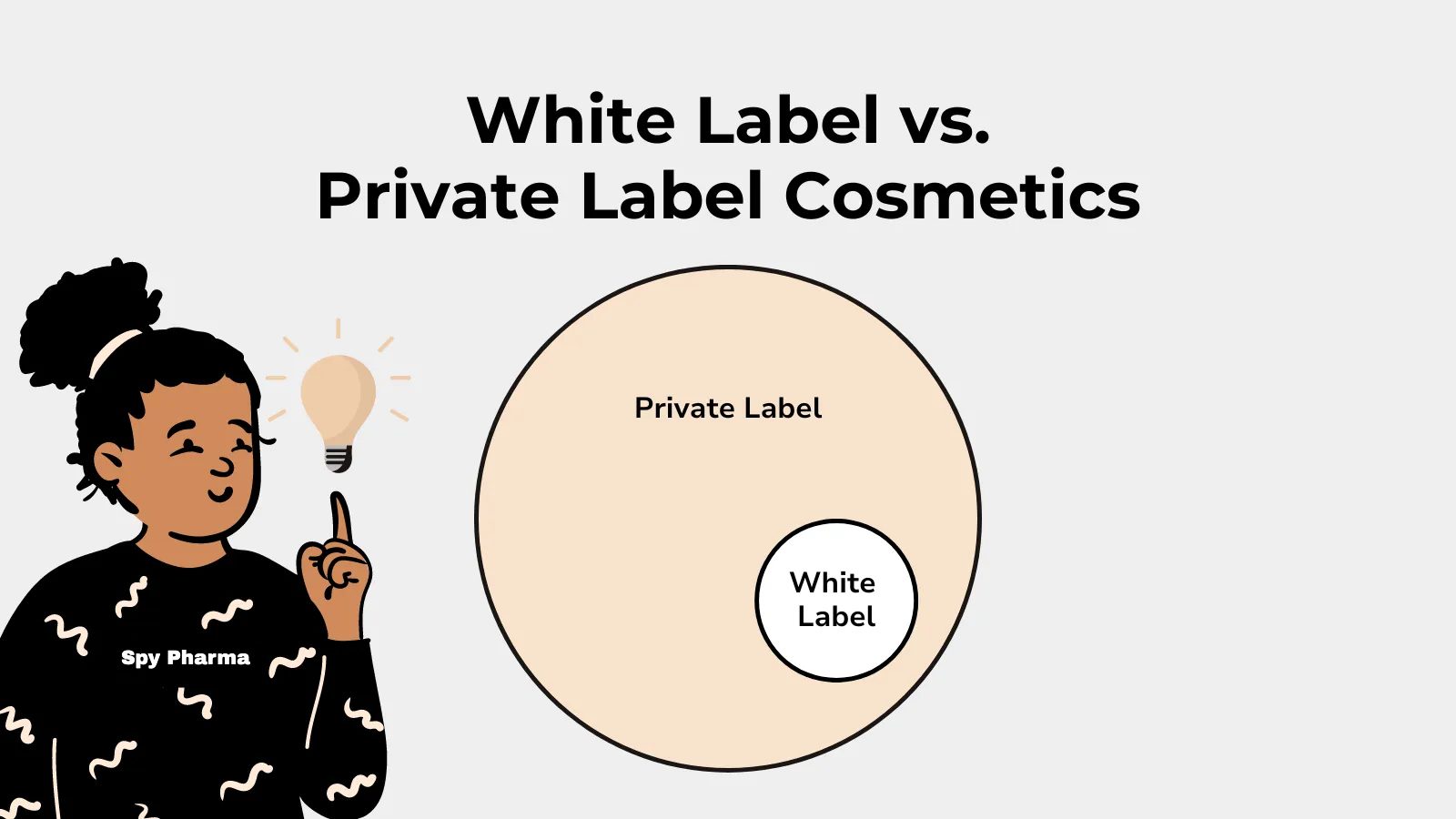
Here is where we, and I think the majority, draws the line.
Private Label Cosmetics
In the most basic sense, private label cosmetics are cosmetics produced by one company but sold under another brand’s name. They can be pre-made and ready for branding (white label), or manufactured just for you.
No matter if they are pre-produced or not, the formulation is already set.
While you usually cannot change the formulation significantly, you can choose basically any packaging you want.
White Label Cosmetics
In our understanding, white label cosmetics is a subcategory of private label cosmetics.
What makes them stand out, is that white label cosmetics are pre-produced.
Neither ingredients nor packaging can be changed. The only thing that can be customized is the print or label of the packaging.
This way you can put your logo on fully finished products.
Pros
Advantages of White Label Cosmetics
There are some pros and cons when choosing to work with a white label manufacturer.
Here the two key advantages.
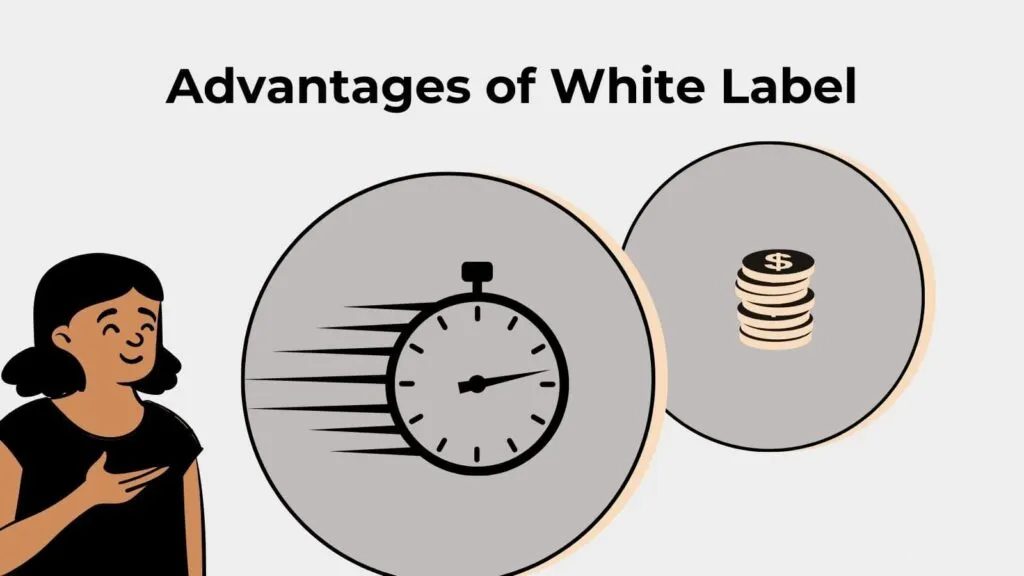
1. Short Production Time
Because white label cosmetics (as we define them) are pre-produced, production time is drastically shortened. The only thing that has to be done, is printing or labelling the products with your logo.
This way you can launch your products in just a few days or weeks.
2. Small Minimum Order Quantities (MOQ)
While minimum order quantities (MOQ) from most cosmetic manufacturers typically range from 3,000 to 5,000 units, you can get white label cosmetics starting from just one single unit.
This minimizes your initial investment and the risk involved.
Being able to do this can be a great advantage for those who want to start a cosmetics line little by little.
Cons
Disadvantages of White Label Cosmetics
If this sounds too good to be true to you, unfortunately I have to tell you, there are some major downsides to white label cosmetics as well.
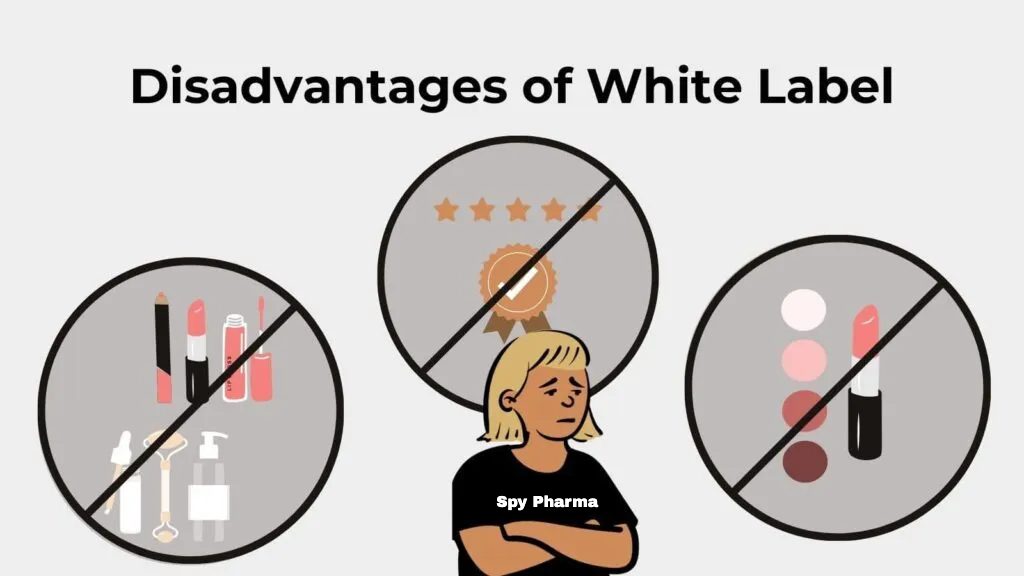
1. High Unit Prices
Per unit, white label cosmetics usually cost a lot more than private label cosmetic products that are not pre-produced. This is because of the low minimum order quantites.
As a rule of thumb:
The unit price drops when order quantity increases.
To give you a deeper understanding of the price differences, we complied a table with rough price estimates for white label cosmetics starting from one unit and private label cosmetics starting from 1000 units.
| Product | 0 MOQ | 1000 MOQ | |
|---|---|---|---|
| 1 | Lipstick | $7.00 — $10.00 | $2.00 — $3.50 |
| 2 | Nail Polish | $6.00 — $8.00 | $1.50 — $3.00 |
| 3 | Mascara | $8.00 — $10.00 | $2.50 — $4.00 |
| 4 | Moisturizer | $18.00 — $25.00 | $5.50 — $8.00 |
| 5 | Powder | $9.00 — $12.00 | $3.00 — $4.50 |
| 6 | Face Brushes | $10.00 — $12.00 | $1.50 — $3.00 |
| 7 | Eyeliner / Lipliner | $5.00 — $7.50 | $1.50 — $2.50 |
| 8 | Foundation | $10.00 — $12.00 | $4.00 — $5.50 |
| 9 | Lipgloss | $6.00 — $8.00 | $2.00 — $3.50 |
| 10 | Shampoo | $15.00 — $18.00 | $5.00 — $7.00 |
2. Low Customization
As already mentioned, the only thing that you can customize about white label cosmetics is putting your logo on them.
It can be done in two ways: printing and labelling.
Which option you have depends on the white label cosmetics supplier.
Try to find a white label supplier that offers printing. For most cosmetic products, printing just looks way better than slapping a label on it (there are exceptions, especially for skin care products, where labelling might be the preferred option).
That said, even with printing your logo on a product, it’s hard to really stand out with a product that is sold by many other brands as well.
3. Poor Quality Level
We have tested many white label cosmetic products and have often found them to be of moderate or even poor quality.
And this makes total sense.
Most high-quality ingredients require high purchase quantities and are costly to source.
If you want to have a small batch of lipsticks with your logo for a company event, the quality might be just fine.
But if you like to sell cosmetics for a premium price, you need premium formulations and packagings. You likely won’t get this quality level from white label cosmetic manufacturers.
4. Limited Product Range
Since a white label cosmetic manufacturer has to have their products on stock, the available options are limited.
They usually focus on bestselling cosmetic products only.
You won’t find any niche or unique products from a white label cosmetics provider.
For example, while you’ll easily find a white label lipstick, you’ll have a hard time finding a white label lash serum or a white label tinted moisturizer.
Guide
How to Start a White Label Cosmetics Brand
Even though we as a private label cosmetics manufacturer are of course convinced of our service and the advantages compared to white label suppliers, we would like to show you a way to start with white label cosmetics.
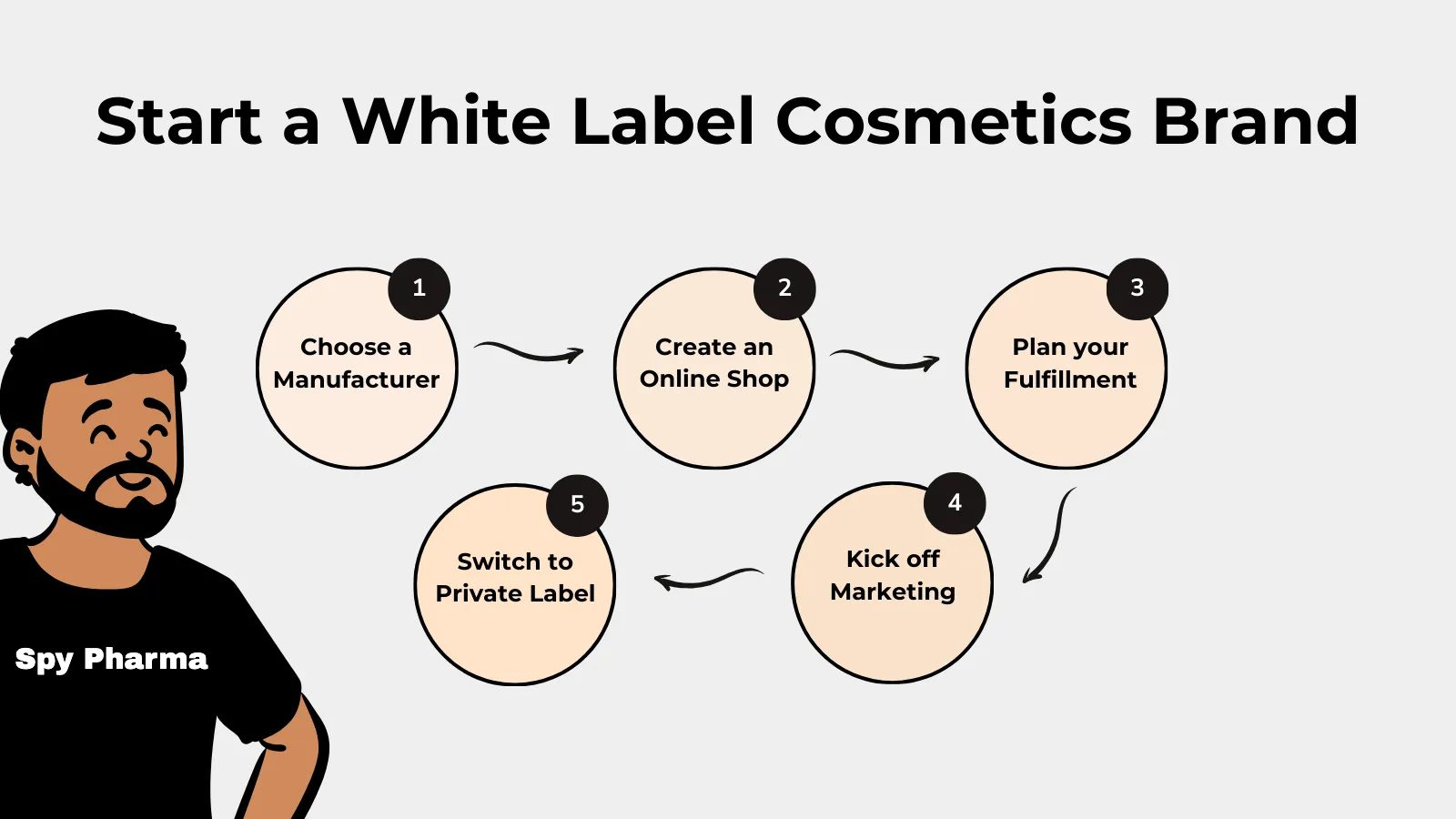
1. Choose a White Label Cosmetics Manufacturer
First, you need to decide on a white label cosmetics manufacturer.
Some popular options are:
2. Create an Online Shop
Due to the high unit prices, you can only sell white label cosmetics profitably via your own online store.
If there is someone in between, such as a retailer, you will no longer have a profit margin.
Shopify is best suited for beginners. It costs around $30 per month, and you can create your own online store in no time.
What many people don’t know is that even big brands, such as Hailey Bieber’s Rhode or Kim Kardashian’s SKKN, use Shopify.
3. Plan Your Fulfilment
You have two options for order processing and shipping:
- Ship it yourself
- Hire a fulfilment service provider
The former is certainly the more obvious option. Especially for the start, you save the fixed costs that are normally incurred with an external shipping service provider.
Once your business is up and running, you can always switch to an external partner. However, it is important to know that this service (packing and shipping) costs at least €2–3 per order plus shipping costs.
So make sure that your profit margin allows for these additional costs.
4. Kick Off Your Marketing
Without marketing efforts, you will soon realize that your online store will hardly have any visitors.
To get started, I recommend you try your luck with TikTok. TikTok is particularly useful because the algorithm works differently to Instagram or Facebook.
Your number of followers has no impact on the visibility of your posts.
You can achieve millions of views with a completely new account (without followers).
No other social media platform makes this so easy.
5. Switch to Private Label Cosmetics
As soon as you have sold enough white label products to cover the initial purchase volume of private label cosmetics, you should definitely make the switch.
It’s time to professionalize yourself and your brand.
This will allow you to create customized products that better match your brand identity and your vision.
More Useful Guides
![Top 17 Cosmetic Manufacturers for Beginners in 2025 [+Guide]](https://www.spypharma.com/uploads/blog/top-17-cosmetics-manufacturers-for-beginnerstop-17-cosmetics-manufacturers-for-beginners.jpg)
Top 17 Cosmetic Manufacturers for Beginners in 2025 [+Guide]
Low MOQ Cosmetic Manufacturers: Be Aware of These Dangers

Ultimate Guide for Vegan Private Label Cosmetics in 2024
![Top 9 Luxury Private Label Cosmetics Manufacturers [+Guide]](https://www.spypharma.com/uploads/blog/luxury-private-label-cosmetics-manufacturers.jpg)
Top 9 Luxury Private Label Cosmetics Manufacturers [+Guide]
![Starting a Lip Gloss Business: A Step-by-Step Guide [2025]](https://www.spypharma.com/uploads/blog/starting-a-lip-gloss-business.jpg)
Starting a Lip Gloss Business: A Step-by-Step Guide [2025]
![Makeup & Cosmetics Packaging: Your Ultimate Guide [2025]](https://www.spypharma.com/uploads/blog/cosmetics-makeup-packaging-your-ultimate-guide.webp)